Hi,
I have taken the decision to merge this blog with my other at:
http://ufos-scientificresearch.blogspot.com
I am finding that despite having downloaded several hundred newspaper items from the digitised newspaper collection at the National Library of Australia's TROVE, that a very high percentage are reports of meteors and meteor trails. There are very few interesting items which have not already been covered in Magonia Downunder blog posts.
I will therefore continue to report any pre 24 June 1947 interesting sightings, on my main blog, along side reporting my research findings in other areas of my interest.
Thanks you for your understanding.
Keith Basterfield.
Tuesday, August 9, 2016

Monday, June 20, 2016
Moira McGhee's new book
Hi,
New South Wales based researcher, Moira McGhee has recently published a new book "Contact Down Under" full of fascinating Australasian sightings and experiences.
Some of these, although not known until post 24 June 1947, are reported to have happened pre 24 June 1947. For the record, I will provide details as Moira presented them in her excellent book.
1924 Coolamon, New South Wales
Some years ago, an elderly man, named Ian Rogers, rang me about an incident when he was a boy in 1924. One morning he was checking their rabbit traps in the Lysterfield State Forest, south of Coolman. He has lived on the family farm there all his life, and in those days rabbits and other game formed a regular part of their diet.
"I was behind a tree, when I heard a humming noise, looked up and saw this flying object which landed in a clearing about 100 yards away. I have never forgotten it, and as best as I can remember, it was a long cylindrical shape, rounded at both ends, with four square windows along the side. It was at least 30 feet long, and I remember lights of some kind.
"I hid behind the tree and watched it for about an hour. At one stage some people got out, they just looked like 'people' and I don't know where they went - they didn't come my way. After about an hour it flew off the ground and away into the sky." I noted there were no helicopters in 1924, and asked him if anything else happened.
"The ground was all burnt black where it had been, and the trees were singed. There were dead birds all around, and nothing grew in that small area for a long time. After it had gone I saw something glinting on the ground. It was a small piece of metal. I kept it for a long time, as it was like magic. When I rubbed it with my hands it would move off of its own accord. I raced home to tell my mother, she scolded me for getting back so late. I don't remember being gone so long, and she said not to tell anyone else about what happened."' (McGhee; pp97-98.)
February 1930 Grose Valley, New South Wales
"Researcher Rex Gilroy received a call from one Sydney woman who was still mystified about the unidentified object she saw years ago when visiting the Blue mountains. She was at Govett's Leap Lookout overlooking the Grose valley, about midday, with her parents and siblings.
"They all saw a big silver object hovering high in the eastern sky above the valley at about cloud level. It was very large, like a big upright triangle with a flat top and attracted a lot of attention from other tourists during the half hour it hovered there. It then flew off eastwards towards Sydney."
(McGhee; p.94.)
February 1943 Darwin, Northern Territory
'W. Wyatt detailed an interesting report from World War 2, when he was a RAAF pilot. All witnesses were trained to identify aerial craft and objects.
"On a clear Darwin February night in 1943, RAAF squadron aircraft were doing 'circuits and bumps' - practice training for pilots in using flare-path landing strips on night flying. We had just received in the last aircraft for the night, and were preparing to refuel and get ready to return to camp, when the warning was given: "Better hit the ground!"
"The alarm was caused by a bright light coming in like another plane, it was soon near us, and went off over the trees. There was no sound whatsoever and steady movement, but much slower than a plane. Our fear came because we knew of a Luftwaffe trick of trying to join up on the tail of Allied aircraft landings in Europe, then strafing and bombing the area as they sped off.
"But this was no plane, Japanese or Allied, and we had never seen a parachute flare or Very flare, ever move under control. Our commanding officer immediately put planes back on readiness but nothing at all happened. To me it was just a large bright light moving over the landing strip, but I have no explanation. Later, our guards company said they had seen similar lights around the area, another night."" (McGhee; p.176.)
1940's, just after World War 2 Wilcannia, New South Wales
"A senior police officer told me of an elderly country woman, now deceased, who saw a traditional flying saucer during daylight hours, near Wilcannia, in western New South Wales, in the 1940's just after World War 2. She claimed that after reporting the sighting to the authorities, she received a letter from the Australian Air Force confirming the report, and warning her not to tell anyone about the craft. The police officer attested to having seen the letter, which appeared to be genuine." (McGhee; p.112.)
New South Wales based researcher, Moira McGhee has recently published a new book "Contact Down Under" full of fascinating Australasian sightings and experiences.
Some of these, although not known until post 24 June 1947, are reported to have happened pre 24 June 1947. For the record, I will provide details as Moira presented them in her excellent book.
1924 Coolamon, New South Wales
 |
| Image courtesy of "Whereis?" |
Some years ago, an elderly man, named Ian Rogers, rang me about an incident when he was a boy in 1924. One morning he was checking their rabbit traps in the Lysterfield State Forest, south of Coolman. He has lived on the family farm there all his life, and in those days rabbits and other game formed a regular part of their diet.
"I was behind a tree, when I heard a humming noise, looked up and saw this flying object which landed in a clearing about 100 yards away. I have never forgotten it, and as best as I can remember, it was a long cylindrical shape, rounded at both ends, with four square windows along the side. It was at least 30 feet long, and I remember lights of some kind.
"I hid behind the tree and watched it for about an hour. At one stage some people got out, they just looked like 'people' and I don't know where they went - they didn't come my way. After about an hour it flew off the ground and away into the sky." I noted there were no helicopters in 1924, and asked him if anything else happened.
"The ground was all burnt black where it had been, and the trees were singed. There were dead birds all around, and nothing grew in that small area for a long time. After it had gone I saw something glinting on the ground. It was a small piece of metal. I kept it for a long time, as it was like magic. When I rubbed it with my hands it would move off of its own accord. I raced home to tell my mother, she scolded me for getting back so late. I don't remember being gone so long, and she said not to tell anyone else about what happened."' (McGhee; pp97-98.)
February 1930 Grose Valley, New South Wales
"Researcher Rex Gilroy received a call from one Sydney woman who was still mystified about the unidentified object she saw years ago when visiting the Blue mountains. She was at Govett's Leap Lookout overlooking the Grose valley, about midday, with her parents and siblings.
"They all saw a big silver object hovering high in the eastern sky above the valley at about cloud level. It was very large, like a big upright triangle with a flat top and attracted a lot of attention from other tourists during the half hour it hovered there. It then flew off eastwards towards Sydney."
(McGhee; p.94.)
February 1943 Darwin, Northern Territory
 |
| Image courtesy "Whereis?" |
"On a clear Darwin February night in 1943, RAAF squadron aircraft were doing 'circuits and bumps' - practice training for pilots in using flare-path landing strips on night flying. We had just received in the last aircraft for the night, and were preparing to refuel and get ready to return to camp, when the warning was given: "Better hit the ground!"
"The alarm was caused by a bright light coming in like another plane, it was soon near us, and went off over the trees. There was no sound whatsoever and steady movement, but much slower than a plane. Our fear came because we knew of a Luftwaffe trick of trying to join up on the tail of Allied aircraft landings in Europe, then strafing and bombing the area as they sped off.
"But this was no plane, Japanese or Allied, and we had never seen a parachute flare or Very flare, ever move under control. Our commanding officer immediately put planes back on readiness but nothing at all happened. To me it was just a large bright light moving over the landing strip, but I have no explanation. Later, our guards company said they had seen similar lights around the area, another night."" (McGhee; p.176.)
1940's, just after World War 2 Wilcannia, New South Wales
 |
| Image courtesy "Whereis?" |
Friday, May 13, 2016
Australian press items re "Foo-Fighters"
Hi,
In my last two posts, I have reported on the search by Melbourne based researcher Paul Dean and I, for potential "Foo-Fighter" sightings from Australia, following the recent interest in this topic generated by long term Boston researcher Barry Greenwood.
While typing up these posts the thought passed through my mind as to whether or not, there were any newspaper articles published in Australia, about this topic during the years of World War II?
I therefore looked at the TROVE digitised newspaper collection, held by the National Library of Australia. Indeed there are such newspaper articles. I located six in all, so far.
In my last two posts, I have reported on the search by Melbourne based researcher Paul Dean and I, for potential "Foo-Fighter" sightings from Australia, following the recent interest in this topic generated by long term Boston researcher Barry Greenwood.
While typing up these posts the thought passed through my mind as to whether or not, there were any newspaper articles published in Australia, about this topic during the years of World War II?
I therefore looked at the TROVE digitised newspaper collection, held by the National Library of Australia. Indeed there are such newspaper articles. I located six in all, so far.
THE ARTICLES
(1) Newcastle Sun (New South Wales) 3 January 1945 page 8.
"Foo fighters are latest
Our special representative
Washington - Tuesday
Pilots flying over Germany at night report that strange balls of fire are following them around on their missions. They have christened these strange phenomena "Foo fighters."
One pilot reported "A Foo Fighter picked me up recently at 700 feet and chased me down the Rhone Valley. I turned to starboard and two red balls of fire turned with me. I turned to port and they turned too. I was doing 260 miles an hour and they kept up with me. I had a horrible thought that the Germans on the ground would press a button and explode them, but they don't explode or attack - they merely follow us like will of the wisps."
Physicists suggest that what was seen was St Elmo's Fire, which, in stormy weather, sometimes appears at the mastheads of ships and on land at the tops of trees and steeples.
It is a sort of electrical discharge, red when positive and blue when negative.
Another suggestion is that they might be gaseous balls of fire controlled by radio from the ground and designed to interfere with radar signals."
(2) Argus (Melbourne) 3 January 1945 page 1.
 |
| Image courtesy of National Library of Australia |
"Germans using fireballs against allied planes
From our correspondent in New York
American pilots are encountering fireballs that race alongside the wings of the American fighter planes over the Reich says American Associated Press correspondent at a US night fighter base. Named "Foo Fighters," these balls keep pace with the planes. There are three varieties - those that fly alongside, others which fly in front of the plane and a third kind seen at a distance in groups of 15.
The Americans believe they are meant to have a psychological effect. They do not attack planes, but follow like will-o-the-wisps."
(3) Barrier Miner (Broken Hill) 4 January 1945 page 7.
"Germans use fireballs
New York
American pilots are encountering fireballs that race alongside the wings of the American fighter planes over the Reich says American Associated Press correspondent at a US night fighter base. Named "Foo Fighters" these balls keep pace with the planes. There are three varieties, the ones which fly alongside, other which fly in front of the plane and a third kind seen at a distance in groups of 15. The Americans believe they are meant to have a psychological effect. They do not attack planes , but follow like will-o-the-wisps."
(4) Army News (Darwin) 9 January 1945 page 3.
 |
| Image courtesy National Library of Australia |
"Balls of fire chased fighters
Washington.
Same text as (1) above.
(5) The Uralla Times (New South Wales) 15 March 1945 page 4.
"Balls of fire race alongside allied planes
A US night fighter base, France Jan 2
The Nazis have thrown something new into the sky over Germany - the weird, mysterious "foo fighter", balls of fire which race alongside the wings of American Beaufighters flying intruder missions over the Reich.
US pilots have been encountering the eerie "foo fighters" for more than a month in their night flights. No one apparently knows exactly what this sky weapon is.
The balls of fire appear suddenly and accompanying the planes for miles. They appear to be radio controlled from the ground and manage to keep up with planes flying 300 miles an hour, official intelligence reports disclose.
'There are three kinds of these lights we call "foo fighters" said Lieut Donald Meiers, of Chicago. "One is red balls of fire which appear off aircraft wing tips and fly along with us, the second is a vertical row of three balls of fire, which fly in front of us and the third is a group of about 15 lights which appear off in the distance - like a Christmas tree up in the air - and flicker on and off."
The pilots of this night fighter squadron - in operations since September 1944 - find these fiery balls the weirdest thing they have as yet encountered. They are convinced that the 'foo fighter' is designed to be a psychological weapon as well as military although it it not the nature of the fireballs to attack planes.
"A 'foo fighter' picked me up recently at 700 feet and chased me 20 miles down the Rhone Valley," Lieut Meiers said. "I turned to starboard and two balls of fire turned with me. I turned to the port side and they turned with me. We were going 260 miles an hour and the balls were keeping right up with us."
"On another occasion when a 'foo fighter' picked us up I dived at 300 miles an hour. It kept right on our wingtips for a while and then zoomed up into the sky.
"When I first saw the things off my wing tips I had the horrible thought that a German on the ground was ready to press a button and explode them. But they didn't explode or attack us. They just seem to follow us like will-o-the-wisps."
An Associated Press report from Paris Dec. 13 said the Germans had thrown silvery balls into the air against day raiders. Pilots then reported they had seen these objects, both individually and in clusters during foreys over the Reich.
Foo Fighters that dog fliers in Europe partly explained
New York Jan 3
The Descriptions of the new German foo fighters, or balls of fire, fit into several well known electrical phenomena.
These are induction, ball lightning and have some, though not all the aspects of St Elmo's Fire. If they are electrical, they are something created in the air close to the planes, rather than anything shot like artillery shells or anything floating in the air and wait for a plane.
Induction is suggested by the report that the foo fighters keep up with the plane's speed, changes in speed, or changes in direction.
Electrical induction of some sort would explain such movement synchronization. Nothing else that is well known would explain such perfect timings. Radio control from the ground does not explain the timing, unless radio control is meant to describe a beam which is part of the automatic induction.
Induction, however, fails completely to describe what happens when a fireball zooms upward leaving its plane. Apparently the balls fly paths thousands of feet away from the planes.
The common experience that resembles this trick is ball lightning. How anyone could produce ball lighting is unknown. Exactly what ball lighting may be is also unknown. But it is a quite harmless thing even as the German foo-balls are reported to be. A lightning ball can explode in your front yard, making a loud bang but doing little or no damage.
St Elmos' Fire is a brush discharge of static electricity, which streams off some solid object with brilliant intensity. Aviators are familiar with brush discharges and would recognise them, so that the foo-balls are probably not ordinary St Elmo's Fire. The deep purple color of brush discharge static would explain the reports that the foo-balls are red. The shade of red has not been reported. Ball lighting has been reported in slightly red shades.
A reason for the foo-balls, again based on experience, is interference with radar, radio or perhaps with a plane's ignition. Ignition interference would stop a plane in the air. It was a real project in Italy before the wat, and how to do it is well known in theory in the United States. All you needed then to stop a plane five or more miles away, was a power plant equal to Niagara Falls.
A guess can be made that the foo-balls are evidence that German natural scientists have found some way to get around part of the power trouble in interference, the fact that they are using them, and so disclosing their secrets to the Allies, would indicate that they do not hope to attain to ignition interference power."
(6) Northern Times (Carnarvon, Western Australia) 29 June 1945 page 2.
"If it was not a hoax or an optical illusion, it was certainly the most puzzling secret weapon that allied fighters have yet encountered.
Recently, night fighter pilots based in France told a strange story of balls of fire which for more than a month had been following their planes at night over Germany. No one seemed to know what, if anything, the fireballs were supposed to accomplish.
Pilots, guessing that it was a new psychological weapon, named it the 'Foo Fighter.' Their description of the apparition varied, but they agreed that the mysterious flares stuck close to their planes and appeared to follow them at high speed for miles. One pilot said that a foo fighter, appearing as red balls of fire off his wing, stuck with him until he dived at 360 miles an hour; then the balls zoomed into the sky.
Sceptical scientists baffled by the whole affair, were inclined to dismiss the fireballs as an illusion, perhaps an after-image of light, which remained in the pilot's eyes after they had been dazzled by flak bursts. But front-line correspondents and arm-chair experts had a field day. They solemnly guessed -
(1) that the balls of fire were radio-controlled (an obvious absurdity, since they could not be synchronized with a plane's movements by remote control;
(2) that they were created by "electrical induction of some sort,"
(3) that they were attracted to a plane by magnetism.
The correspondents guessed that foo fighters were initiated -
(1) to dazzle pilots;
(2) to serve as aiming points for anti-aircraft gunners;
(3) to interfere with a plane's radar;
(4) to cut a plane's ignition, thus stop its engine in mid-air.
Some scientists suggested another possibility, that the foo-balls were nothing more than St Elmo's Fire, a reddish, brush-like discharge of atmospheric electricity which has often been seen near the tips of church steeples, ships' masts and yardarms."
My comments
1. These articles, even though they are spread across January to June 1945, seem to come from one primary source. The Uralla Times article provides the lengthiest reporting, derived, it says from a US night fighter base in France, and cites a date of 2 January 1945.
2. It is noted that none of the six articles, mentions,whether or not, any similar reports were appearing in the Pacific region of the war.
3. I also note that many of the documents in the National Archives of Australia's files, which have bee referenced in my earlier two blog posts about this subject, have been marked "secret." Thus in early 1945 it is unlikely that anyone outside of the Australian Department of Defence, would have been aware of any similar sightings by RAAF crews flying in the Pacific war arena.
The search, by Melbourne based researcher Paul Dean and I, for additional similar sightings by RAAF aircrews, will continue.
Tuesday, May 10, 2016
The "rockets" of 20 Squadron
Hi,
I have now been through two more files from the National Archives of Australia, looking for possible "Foo-Fighters" like sightings.
The first file was NAA file series A9652 control symbol box 15, barcode 13057971, titled "RAAF squadron narrative reports - 18 squadron" based in Australia. Its date range was January 1944 to May 1945. I found nothing of interest.
The second file was NAA file series A9652 control symbol box 16, barcode 13057972, titled "RAAF squadron narrative reports - 20, 21 and 22 squadrons" with a date range of October 1943 to May 1945. I found the following.
(1) 16 June 1943.
a. An aircraft of 20 squadron was on its way to Langgoer at night.

"On way to target rockets observed Mandek Is, Banda Is, SE tip Ceram. Over Laha 16/1300z - 1415 z. Cloud too thick and ASV u/s. Nil visibility at Langgoer..." Pilot was F/l Read.
b. A second aircraft on its way to Langgoer at night.

"Rocket observed 60 miles SE of Banda Is. Burst at 2000 feet & red stars emerged..." Pilot was F/l Weaver.
c. A third aircraft on its way to Langgoer at night.
"3/10 cloud base 2500. Visibility good. ASV u/s. 16/1145z observed rocket + possible navigation lights of a/c west of Tanimbar islands. Some minutes later rocket observed to port again." Pilot was w/c Stilling.
I note that the reports were careful to use terms such as verey light; unidentified aircraft; searchlight etc. when describing what they were seeing. Out of 851 pages on this file, with several hundred action reports, I located only the three above and the one below which used the term "rocket."
(2) 15 October 1944.
A 20 squadron aircraft on its way at night, reported:

"White rocket sighted from position half way along North coast Madoera Island 1400z."
I have now been through two more files from the National Archives of Australia, looking for possible "Foo-Fighters" like sightings.
The first file was NAA file series A9652 control symbol box 15, barcode 13057971, titled "RAAF squadron narrative reports - 18 squadron" based in Australia. Its date range was January 1944 to May 1945. I found nothing of interest.
The second file was NAA file series A9652 control symbol box 16, barcode 13057972, titled "RAAF squadron narrative reports - 20, 21 and 22 squadrons" with a date range of October 1943 to May 1945. I found the following.
(1) 16 June 1943.
a. An aircraft of 20 squadron was on its way to Langgoer at night.

"On way to target rockets observed Mandek Is, Banda Is, SE tip Ceram. Over Laha 16/1300z - 1415 z. Cloud too thick and ASV u/s. Nil visibility at Langgoer..." Pilot was F/l Read.
b. A second aircraft on its way to Langgoer at night.

"Rocket observed 60 miles SE of Banda Is. Burst at 2000 feet & red stars emerged..." Pilot was F/l Weaver.
c. A third aircraft on its way to Langgoer at night.
"3/10 cloud base 2500. Visibility good. ASV u/s. 16/1145z observed rocket + possible navigation lights of a/c west of Tanimbar islands. Some minutes later rocket observed to port again." Pilot was w/c Stilling.
I note that the reports were careful to use terms such as verey light; unidentified aircraft; searchlight etc. when describing what they were seeing. Out of 851 pages on this file, with several hundred action reports, I located only the three above and the one below which used the term "rocket."
(2) 15 October 1944.
A 20 squadron aircraft on its way at night, reported:

"White rocket sighted from position half way along North coast Madoera Island 1400z."
Sunday, May 8, 2016
The search for "Foo-Fighters" reports from Australia
Hi,
"Strange Company: Military Encounters with UFOs in World War II" authored by Keith Chester (published by Anomalist Books in 2007) is an excellent resource concerning information about "Foo-Fighters."
US researcher Barry Greenwood was recently the recipient of 8000 pages of documentation about "Foo-Fighters" from Chester. Discussions between Greenwood and Melbourne based researcher Paul Dean, raised the possibility of a search for any similar sightings buried in military records held by the National Archives of Australia (NAA).
Paul Dean has already posted two blog posts on his own blog. Click here and here to read these. Paul later located, several potentially interesting files in the NAA. Paul and I have divided these up in order to search through them. These files contain dozens of intelligence reports of missions flown out of Australia.
So far, a two hour search by myself has reviewed NAA file series A9652, control symbol Box 14, barcode 13057920. It is titled "RAAF Squadron narrative reports - 18 Squadron" and dated 1943.
On this file, I found two potentially interesting observations.
(1) "Unexplained sightings."

On the 26 June 1943, aircraft undertook Operation NEI 18 which was to attack Penfoey in order to destroy any aircraft at the aerodrome. Unusually, the mission report has an additional paragraph titled "Unexplained Sightings."
"Bombadier on Duty three reports that he experienced for a second time a peculiar light underneath the plane, thought to be at ground level, dull streaks, which follow a wavy course, but on the whole follow the same course as the aircraft.
Smoke has been seen similar to that emitted from a rocket. Left behind as the object shoots along, and the rate of travel is fairly fast.
A more close look will be kept on the next mission to obtain further details. Bombadier did not report this on the first time seen as he did not pay much attention, and was not sure he had actually seen the occurrence on the first occasion of sighting."
The Bombadier on Duty three was listed as "Sgt. McPhee."
(2) "Unexplained occurrence."

"On the 24 July 1943, aircraft conducted Operation NEI 36, which was to attack the Koepang and Tenau areas.
Aircraft Duty 8 "...reports while passing over Babaoe a verey light, blue to white light shone for 2-3 seconds in that vicinity."

"Bombadier Duty 8 states that he would not have reported this occurrence but for the fact that the light went up. Other observers have discussed question before and always estimated that lights seen were shooting stars, but as streak went up Bomabdier mentioned this fact.
The supposition is now put forward that the lights signal (reported above) and the absence of A/A may indicate the presence of night fighters.
Observer states that the light went overhead and ahead, rose up and then suddenly stopped. The rise coupled with the sudden extinguishment would seem to preclude any possibility of a shooting star. Aircraft was at the time flying straight and steady.
It is known that enemy aircraft do not always attack when flying at night (see Summary No. 104, Paras 52 to 63) and it may be that the enemy is practising in this theatre to endeavour to effect interceptions.
One noticeable difference is the absence of searchlights. No sighting of enemy aircraft was made."
The mission report gives the name of the Duty 8 Bombadier as F/O Simpson.
Paul and I will bring you any other observations which we find on this series of files.
"Strange Company: Military Encounters with UFOs in World War II" authored by Keith Chester (published by Anomalist Books in 2007) is an excellent resource concerning information about "Foo-Fighters."
 |
| Image courtesy of Amazon Books |
US researcher Barry Greenwood was recently the recipient of 8000 pages of documentation about "Foo-Fighters" from Chester. Discussions between Greenwood and Melbourne based researcher Paul Dean, raised the possibility of a search for any similar sightings buried in military records held by the National Archives of Australia (NAA).
Paul Dean has already posted two blog posts on his own blog. Click here and here to read these. Paul later located, several potentially interesting files in the NAA. Paul and I have divided these up in order to search through them. These files contain dozens of intelligence reports of missions flown out of Australia.
So far, a two hour search by myself has reviewed NAA file series A9652, control symbol Box 14, barcode 13057920. It is titled "RAAF Squadron narrative reports - 18 Squadron" and dated 1943.
On this file, I found two potentially interesting observations.
(1) "Unexplained sightings."

On the 26 June 1943, aircraft undertook Operation NEI 18 which was to attack Penfoey in order to destroy any aircraft at the aerodrome. Unusually, the mission report has an additional paragraph titled "Unexplained Sightings."
"Bombadier on Duty three reports that he experienced for a second time a peculiar light underneath the plane, thought to be at ground level, dull streaks, which follow a wavy course, but on the whole follow the same course as the aircraft.
Smoke has been seen similar to that emitted from a rocket. Left behind as the object shoots along, and the rate of travel is fairly fast.
A more close look will be kept on the next mission to obtain further details. Bombadier did not report this on the first time seen as he did not pay much attention, and was not sure he had actually seen the occurrence on the first occasion of sighting."
The Bombadier on Duty three was listed as "Sgt. McPhee."
(2) "Unexplained occurrence."

"On the 24 July 1943, aircraft conducted Operation NEI 36, which was to attack the Koepang and Tenau areas.
Aircraft Duty 8 "...reports while passing over Babaoe a verey light, blue to white light shone for 2-3 seconds in that vicinity."

"Bombadier Duty 8 states that he would not have reported this occurrence but for the fact that the light went up. Other observers have discussed question before and always estimated that lights seen were shooting stars, but as streak went up Bomabdier mentioned this fact.
The supposition is now put forward that the lights signal (reported above) and the absence of A/A may indicate the presence of night fighters.
Observer states that the light went overhead and ahead, rose up and then suddenly stopped. The rise coupled with the sudden extinguishment would seem to preclude any possibility of a shooting star. Aircraft was at the time flying straight and steady.
It is known that enemy aircraft do not always attack when flying at night (see Summary No. 104, Paras 52 to 63) and it may be that the enemy is practising in this theatre to endeavour to effect interceptions.
One noticeable difference is the absence of searchlights. No sighting of enemy aircraft was made."
The mission report gives the name of the Duty 8 Bombadier as F/O Simpson.
Paul and I will bring you any other observations which we find on this series of files.
Thursday, March 17, 2016
No posts of late
Hi
Due to a recent death in the family, there will be no posts to this blog, for a while. I hope to resume posting here in about a month.
Due to a recent death in the family, there will be no posts to this blog, for a while. I hope to resume posting here in about a month.
Wednesday, January 20, 2016
31 March 1907 - Cairns, Queensland, Australia - an Easter Venus?
Hi all,
The recent book "Return to Magonia" by Chris Aubeck and Martin Shough, features a number of observations from Australia. One of these (on pages 228-229) was from North Queensland in 1907, as described in the "Morning Post" Cairns, dated Tuesday 16 April 1907, page 4.

The text of the article reads as follows:
"A brilliant spectacle.
(From Port Douglas 'Record.')
A very brilliant comet was observed from Port Douglas on Easter Sunday morning at about half past three. We presume it was the one predicted by Professor Matteuci to strike the earth with disastrous results at the latter end of last month, and judging by the description given below, must have been perilously close. Our exchanges the Kuranda make no reference whatsoever to the matter, so it appears not to have been a subject of general observation. So far as we can learn the only person in the district fortunate enough to witness the astral body in all its glory were the Misses Hasenkamp, one of whom (Miss Dora) has kindly written the following description for the 'Record.'
At about 3.30am on the 31st March (Easter Sunday morning) I was awakened by my sister Florry calling me to get up and look at the comet.
I arose and saw in the eastern sky a large dazzling bright star which appeared to be as large as a football. Its brilliant light dazzled my eyes for a few seconds. When I looked again it had thousands of small glittering spikes of silvery light, and on the top right hand side of it, a long rod resembling the flame of a candle-light, about two foot in length, appeared with another tail in the shape of a half-circle - which faced down towards the earth - attached to it.
The circle shaped rod had a couple of lights like red hot coals. I was looking at the comet for about a quarter of an hour when it gradually faded away into the sky, and the atmosphere became very cold. The comet again appeared shining as before, the lights on the lower rods getting fainter.
The moon was shining bright all the time and had three black spots on it. The comet was moving very slowly and appeared to be going in the direction of the moon. I watched for about another half hour and then it disappeared altogether. It was the most brilliant sight I ever saw."

The recent book "Return to Magonia" by Chris Aubeck and Martin Shough, features a number of observations from Australia. One of these (on pages 228-229) was from North Queensland in 1907, as described in the "Morning Post" Cairns, dated Tuesday 16 April 1907, page 4.
The account

The text of the article reads as follows:
"A brilliant spectacle.
(From Port Douglas 'Record.')
A very brilliant comet was observed from Port Douglas on Easter Sunday morning at about half past three. We presume it was the one predicted by Professor Matteuci to strike the earth with disastrous results at the latter end of last month, and judging by the description given below, must have been perilously close. Our exchanges the Kuranda make no reference whatsoever to the matter, so it appears not to have been a subject of general observation. So far as we can learn the only person in the district fortunate enough to witness the astral body in all its glory were the Misses Hasenkamp, one of whom (Miss Dora) has kindly written the following description for the 'Record.'
At about 3.30am on the 31st March (Easter Sunday morning) I was awakened by my sister Florry calling me to get up and look at the comet.
I arose and saw in the eastern sky a large dazzling bright star which appeared to be as large as a football. Its brilliant light dazzled my eyes for a few seconds. When I looked again it had thousands of small glittering spikes of silvery light, and on the top right hand side of it, a long rod resembling the flame of a candle-light, about two foot in length, appeared with another tail in the shape of a half-circle - which faced down towards the earth - attached to it.
The circle shaped rod had a couple of lights like red hot coals. I was looking at the comet for about a quarter of an hour when it gradually faded away into the sky, and the atmosphere became very cold. The comet again appeared shining as before, the lights on the lower rods getting fainter.
The moon was shining bright all the time and had three black spots on it. The comet was moving very slowly and appeared to be going in the direction of the moon. I watched for about another half hour and then it disappeared altogether. It was the most brilliant sight I ever saw."

What was it?
In looking to identify this "comet,"Aubeck and Shough wrote:
"The interesting and perhaps educative thing about this case is that at the time reported the planet Venus, with a respectable magnitude -3.6 had just risen over the eastern horizon and would have been a prominent sight in the pre-dawn sky, just where the strange object was. The moon was bright, as stated, approximately full and about 30 degrees west of the zenith; and Venus climbing on its normal motion along the ecliptic would have progressed "very slowly in the direction of the moon" until it faded in the daylight. So it is hard not to conclude that Venus was the culprit in this case, and the peculiar structures of rods and red lights must have been an illusion caused by glare or some sort of
ocular or instrumental defect."
Just checking
1. Port Douglas, is north at Cairns, Queensland at latitude 16.5 degrees south; longitude 145.5 degrees east.
2. On the 31 March 1907, sunrise that morning was at 0623 hours. Therefore the start of the 45 minute observation, was almost three hours before sunrise.
3. A check using an electronic sky chart reveals that the Sun was about 41 degrees below the eastern horizon at the time; the moon was at 53 degrees elevation, azimuth 18 degrees north of west; and Venus was on the horizon rising at azimuth 13 degrees south of east.
4. Interestingly, the witnesses did not report seeing both the planet Venus and a "comet."
5. There are some oddities in the account. What are we to make of the observer's description that "The moon was shining bright and had three black spots on it?" It's a pity that we have no idea as to whether or not Dora had been prescribed spectacles, and whether or not she was wearing them at the time.
6. Were the Hasenkamps historical figures?
A search of TROVE electronic newspapers revealed two article mentioning them.
a. Page 4 of the "Townsville Daily Bulletin" dated Tuesday 30 November 1926 stated that a Dora Hasenkamp managed the central Hotel in Port Douglas and indicated that she "...has been in Port Douglas for some time."
b. Page 11 of the "Cairns Post" [Qld:1909-1954] dated 25 May 1933 referenced a Miss Dora Hasenkamp and her sister Flo, who were both included in a wedding party.
Therefore, it would seem that they were historical figures, and that there is not reason to suspect that the letter to the editor is not genuine.
7. I could not locate any weather details for Port Douglas for 31 March 1907.
8. The original account appears to have come from a newspaper named "Port Douglas 'Record." The TROVE collection doesn't have issues of this newspaper.
9. Are there any other local references to comets, that would explain why the 16 April 1907 article referred to what was seen, on 31 March 1907, as "A very brilliant comet?" Indeed there are.
a. On page 3 of the "Morning Post" Cairns, paper dated 27 February 1907, there is a short piece about an approaching comet, citing a Professor Matteuci who "...declares that about the end of March...the comet...will come in contact with the earth's atmosphere, causing some damage."
b. Further discussions about this comet appear on page 6 of the "Morning Post" Cairns dated 11 March 1907; and page 4 of the 22 March 1907 edition of the same paper.
It would appear reasonable, given these three articles about a comet; for the editor of the "Morning Post" Cairns, on the 16 April 1907, to suppose Miss Hasenkamp's observation was that of a "comet."
10. In conclusion, given all of the above information, I support Aubeck's and Shough's view that what was seen was most likely the planet Venus.
Tuesday, January 19, 2016
Port Augusta, South Australia - "flying eggs" - 1947 - witness deceased
Hi all,
Thanks to an observant Adelaide individual, I have now found out that Ronald Ernest Ellis, the main witness of the pre Kenneth Arnold, "flying eggs", at Port Augusta in 1947, passed away on 15 July 2008, aged 87 years. He is buried in the Stirling North Garden Cemetery.
The same Adelaide man, also directed my attention to a photograph of Ellis, which I reproduce below.
In another previous post, I advised that I was aware that an Adelaide researcher, whose first name was Mishelle, managed to locate and interview Ellis in 2006. Although a preliminary report was available of this interview, no final report is known. I believe that Adelaide researcher Jeff Fausch, has now located Mishelle. Jeff is awaiting direct contact with Mishelle, to see if we can obtain a more detailed report of her interview with Ellis.
Thanks to an observant Adelaide individual, I have now found out that Ronald Ernest Ellis, the main witness of the pre Kenneth Arnold, "flying eggs", at Port Augusta in 1947, passed away on 15 July 2008, aged 87 years. He is buried in the Stirling North Garden Cemetery.
The same Adelaide man, also directed my attention to a photograph of Ellis, which I reproduce below.
 |
| Source: http://www.portaugusta.rslsa.org.au/gallery/index.cfm?fuseaction=display_main&GalleryTypeID=4017&OrgID=1247 |
In another previous post, I advised that I was aware that an Adelaide researcher, whose first name was Mishelle, managed to locate and interview Ellis in 2006. Although a preliminary report was available of this interview, no final report is known. I believe that Adelaide researcher Jeff Fausch, has now located Mishelle. Jeff is awaiting direct contact with Mishelle, to see if we can obtain a more detailed report of her interview with Ellis.
Tuesday, January 12, 2016
Disk-like object - Berrigal Creek, New South Wales - 1931
Hi readers,
Introduction
In 1969, the author of a soon to be published book called upon individuals to send in their sighting reports to him, for inclusion in the book. The author was one Michael Hervey; the book was titled "UFOs Over the Southern Hemisphere," and it was published by Horwitz of Sydney. Quite a number of individuals related their stories to Hervey, and they duly appeared in the published work. One of the accounts was as follows.
Since 1969, this observation has been referred to a number of time, by various Australian UFO researchers, including Sydney based Bill Chalker, e.g. on his blog. However, I have never seen any deep analysis of the event, such as I provide below.
Since 1969, this observation has been referred to a number of time, by various Australian UFO researchers, including Sydney based Bill Chalker, e.g. on his blog. However, I have never seen any deep analysis of the event, such as I provide below.
The account
"In the year 1931, at the age of thirteen, while out rabbiting one night on a property in Berrigal Creek, part of the Nandewar Ranges, I noticed the countryside lit up, as if by a yellowish moon light, yet there was no moon.
I raised my eyes and there, low in the sky in the north-west was a round disk-like object, yellowish in colour, travelling south, without a sound. It was rotating slowly, travelling at a steady pace, not fast, on a dead even course with no variation in altitude.
The object, which seemed to have small flames licking over it all the while, travelled over a peak of a hill about half-a-mile away and across a gap in the hills towards a mountain almost 2000 feet above sea level.
The object came to one of the peaks, went behind it and reappeared the other side and continued on to the largest peak and swooped towards the rear of it and disappeared.
At that time there wasn't any talk of flying saucers or UFOs. I heard about fireballs a little later and thought for a time it must have been one of these. However I have read some detailed reports of fireballs since, and the description doesn't fit. For one thing, it was a fine clear night with no clouds.
Jack Howlett, Baradine."
Research notes
1. Berrigal Creek is near Bellata, in New South Wales. Bellata's latitude is 29 degrees 54 mins south; longitude 149 degrees 48mins east.
2. The Nandewar Ranges consist of numerous peaks, up to the 4885 foot (1489m) peak named Mount Kaputar. I found a list of ten peaks in the ranges, all about 3323 feet (1013m) tall, but no listed peaks of around 2000 feet high.
3. The book account mentions that it "...continued on to the largest peak and swooped towards the rear of it and disappeared." The "tallest" peak is Mount Kaputar, height 4885 feet which is at latitude 30 deg 16 mins south and longitude 150 deg 10 mins east.
4. I checked Ancestry.com and in the New South Wales 1948 electoral roll, I located a Jack Howlett, in the subdivision of Baradine, division of Gwydir, living with Ivy Helen Howlett in Wellington Street. The electoral rolls indicate they were living there in 1969 when the letter to Hervey was written. This Jack Howlett was born in 1918 and would have been 13 in 1931 the year of the sighting. He died in 1986.
 |
| Courtesy Google Maps |
2. The Nandewar Ranges consist of numerous peaks, up to the 4885 foot (1489m) peak named Mount Kaputar. I found a list of ten peaks in the ranges, all about 3323 feet (1013m) tall, but no listed peaks of around 2000 feet high.
 |
| Courtesy Google maps |
3. The book account mentions that it "...continued on to the largest peak and swooped towards the rear of it and disappeared." The "tallest" peak is Mount Kaputar, height 4885 feet which is at latitude 30 deg 16 mins south and longitude 150 deg 10 mins east.
4. I checked Ancestry.com and in the New South Wales 1948 electoral roll, I located a Jack Howlett, in the subdivision of Baradine, division of Gwydir, living with Ivy Helen Howlett in Wellington Street. The electoral rolls indicate they were living there in 1969 when the letter to Hervey was written. This Jack Howlett was born in 1918 and would have been 13 in 1931 the year of the sighting. He died in 1986.
Analysis
1. For an observer near Bellata, to see the object pass behind peaks, which are at a distance of at least 30 kilometres away, indicates that the object was at an extremely low angular elevation above the horizon, which agrees with the observer's statement that the object was "low in the sky."
2. The statement by Howlett that "I noticed the countryside lit up, as if by a yellowish moon light, yet there was no moon" reminds me of numerous descriptions I have read of the sudden appearance of a meteor. Indeed one night I was out in my own back garden when the whole area was lit up in brilliant blue light, heralding the arrival of a bright meteor.
3. I wonder if the comment that it looked like "...a round disk-like object..." refers to it appearing like a circle, and not to a "dish" or "saucer shaped" object. There has been some tendency among certain UFO researchers to look for pre 1947 "disk" shaped objects and shout "It's a UFO."
In their recent book, "Return to Magonia" (2015. Anomalistic Books. San Antonio) authors Chris Aubeck and Martin Shough, spent some time in chapter five, discussing the meaning when an early sighting report speaks of a "disc." On page 87 they write "Some writers have claimed that there is a tradition of saucer shaped anomalies, perhaps going back to antiquity. In our opinion the search for flying discs in old sources is often motivated more by a desire to promote the theory of ET contact than by dispassionate consideration of evidence in context."
4. The description "...which seemed to have small flames licking over it all the while,.." is certainly similar to a description of a meteor.
5. The observation ended when the object "...disappeared." It is uncertain from this whether the light from the object went out, or whether the object disappeared due to distance, and perhaps passed over the horizon.
6. I believe Howlett's comment about the description of "fireballs" not fitting his observation, may refer to the older term "fireball" which was associated with thunderstorms, and seems to fit the newer designation "ball lightning."
7. I looked for contemporary newspaper article about this object, via the TROVE electronic newspaper collection. I found the following, from the year 1931.
a. "Brisbane Courier" [Qld: 1864-1933] Friday 23 October 1931 p 18.
On the 17 October 1931 between about 1900 and 1930hrs there were reports of a bright object a "...little above the horizon north of west" from Roma, Qld.
"Daily Examiner" [Grafton, NSW: 1915-1954]Tuesday 20 October 1931 p. 5.
Reports at 1900hrs 17 October of a phenomenon north-west of Mitchell Qld. Yellowish white in colour. Lasted 30 minutes.
"The Longreach Leader" [Qld 1923-1938] Friday 23 October 1931 p.5.
Phenomenon seen from Mitchell in south-west Queensland and Winton, Queensland.
There were even two photographs taken of this 17 October 1931 event; see my previous Magoniadownunder blog post.
However, looking at the locations of these observations and the details provided, it does not fit in with the Berrigal Creek data.
b. "Murray pioneer and Australian River Record" [Renmark, SA: 1913-1943] Friday 26 June 1931 p.5.
Multiple reports of a bright meteor and ground shaking. The colour, direction of flight and other characteristics do not fit in with the Berrigal Creek observation.
Despite a fairly wide search, I was unable to locate any TROVE newspaper article which matched the Berrigal Creek sighting.
8. In my opinion, the best fit for this observation is a bright meteor.
I welcome comments from blog readers.
2. The statement by Howlett that "I noticed the countryside lit up, as if by a yellowish moon light, yet there was no moon" reminds me of numerous descriptions I have read of the sudden appearance of a meteor. Indeed one night I was out in my own back garden when the whole area was lit up in brilliant blue light, heralding the arrival of a bright meteor.
3. I wonder if the comment that it looked like "...a round disk-like object..." refers to it appearing like a circle, and not to a "dish" or "saucer shaped" object. There has been some tendency among certain UFO researchers to look for pre 1947 "disk" shaped objects and shout "It's a UFO."
In their recent book, "Return to Magonia" (2015. Anomalistic Books. San Antonio) authors Chris Aubeck and Martin Shough, spent some time in chapter five, discussing the meaning when an early sighting report speaks of a "disc." On page 87 they write "Some writers have claimed that there is a tradition of saucer shaped anomalies, perhaps going back to antiquity. In our opinion the search for flying discs in old sources is often motivated more by a desire to promote the theory of ET contact than by dispassionate consideration of evidence in context."
4. The description "...which seemed to have small flames licking over it all the while,.." is certainly similar to a description of a meteor.
5. The observation ended when the object "...disappeared." It is uncertain from this whether the light from the object went out, or whether the object disappeared due to distance, and perhaps passed over the horizon.
6. I believe Howlett's comment about the description of "fireballs" not fitting his observation, may refer to the older term "fireball" which was associated with thunderstorms, and seems to fit the newer designation "ball lightning."
7. I looked for contemporary newspaper article about this object, via the TROVE electronic newspaper collection. I found the following, from the year 1931.
a. "Brisbane Courier" [Qld: 1864-1933] Friday 23 October 1931 p 18.
On the 17 October 1931 between about 1900 and 1930hrs there were reports of a bright object a "...little above the horizon north of west" from Roma, Qld.
"Daily Examiner" [Grafton, NSW: 1915-1954]Tuesday 20 October 1931 p. 5.
Reports at 1900hrs 17 October of a phenomenon north-west of Mitchell Qld. Yellowish white in colour. Lasted 30 minutes.
"The Longreach Leader" [Qld 1923-1938] Friday 23 October 1931 p.5.
Phenomenon seen from Mitchell in south-west Queensland and Winton, Queensland.
There were even two photographs taken of this 17 October 1931 event; see my previous Magoniadownunder blog post.
However, looking at the locations of these observations and the details provided, it does not fit in with the Berrigal Creek data.
b. "Murray pioneer and Australian River Record" [Renmark, SA: 1913-1943] Friday 26 June 1931 p.5.
Multiple reports of a bright meteor and ground shaking. The colour, direction of flight and other characteristics do not fit in with the Berrigal Creek observation.
Despite a fairly wide search, I was unable to locate any TROVE newspaper article which matched the Berrigal Creek sighting.
8. In my opinion, the best fit for this observation is a bright meteor.
I welcome comments from blog readers.
Friday, January 8, 2016
Flying eggs - Port Augusta 1947 - main witness was interviewed in 2006
Hi readers,
There has been renewed interest of late, in an event which happened on 5 February 1947, at Port Augusta, South Australia. The case recently featured as chapter 21 in "Return to Magonia" by Chris Aubeck and Martin Shough (2015. Anomalistic Books. San Antonio.) You might care to refresh your memory of the details I published in an earlier post before reading further.

There has been renewed interest of late, in an event which happened on 5 February 1947, at Port Augusta, South Australia. The case recently featured as chapter 21 in "Return to Magonia" by Chris Aubeck and Martin Shough (2015. Anomalistic Books. San Antonio.) You might care to refresh your memory of the details I published in an earlier post before reading further.
Main witness interviewed
Adelaide based researcher Jeff Fausch conducted his own "cold case" investigation into the Port Augusta event. One previously unknown aspect, is that the main witness, Ron Ellis was located and interviewed in 2006 by a researcher whose first name is Mishelle. In a recent email to me, Jeff informs us:
"After I had been to the State Library in June 2006 to view the Adelaide newspaper article for myself and to make copies, I contacted Mishelle to give her a copy of the original accounts. She told me that the man interviewed in the article from February 7th 1947, Ron Ellis was alive and only lived a couple of streets away.
Mishelle interviewed Ron Ellis in June 2006 sending me a couple of updates, but in September 2006 told me that her husband was being transferred to Kalgoorlie, Western Australia. When she moved to Kalgoorlie I lost contact with her and have not heard from her since. The information I am using for my project is from emails sent to me before loosing contact with her.
In an email sent to me on June 29th 2006 Mishelle said that she had interviewed Ron Ellis who was at the time, 86 years old. His report of the incident conflicts with that of the media article in terms of what he witnessed, who was spoken to etc. Mr Ellis first told Mishelle he saw nothing at first, then changed his story, and was then adamant that what he witnessed was a weather/observation balloon. This is as told to him by unknown benefactors after the article was published.
During a phone call, Mishelle told me that Ellis was approached by two men who told him that it was a weather balloon and to leave it at that. Mishelle felt that there was much more to this sighting than met the eye. I believe when Mishelle approached him, he had been taken by surprise as no one had brought this up for nearly sixty years. Unfortunately I lost contact with her after this email so I have not seen the finished report on the interview with Ron Ellis.
In Mishelle's last email she also mentioned that she had contacted the department of Meteorology, specifically the climate services section, and was informed that the closest area to Port Augusta in which weather balloons were launched was Woomera, but interestingly, upper air observations did not begin at Woomera until March 1st 1949, two years after the Port Augusta incident."
Tuesday, December 29, 2015
Unknown spherical body - Tasmania - 6 January 1923
Hi readers,
In my last post, I presented information about an "Extraordinary Phenomenon" seen at Alpha. Queensland on 17 September 1900. This concerned a "travelling star" seen in the daytime. I noted that in this instance it might have been a wind borne object.
Today's post concerns a daytime, revolving "...spherical body" travelling "...against the prevailing wind."
In my last post, I presented information about an "Extraordinary Phenomenon" seen at Alpha. Queensland on 17 September 1900. This concerned a "travelling star" seen in the daytime. I noted that in this instance it might have been a wind borne object.
Today's post concerns a daytime, revolving "...spherical body" travelling "...against the prevailing wind."
The account
"An Unusual Phenomenon.
To the Editor of "The Mercury."
Sir - I am interested to know if any beside myself and daughter witnessed an extraordinary appearance in the sky at about 12.30 on Saturday. The sky was intensely blue with an occasional formation of cloud scudding over from the north-west.
On a clear patch of sky, a spherical body, creamy white in colour was revolving on its own axis, and speeding in a northerly direction at an great pace against the prevailing wind. The object was above the clouds as occasionally it was observed to repeatedly appear further on. It was not luminous like a star, or a meteor and was seen for nearly half an hour until eventually obscured by rain clouds.
Yours etc.
E.W."
Source: "The Mercury" [Hobart, Tas: 1860-1954] Thursday 11 January 1923 p9.


Notes
1. If the location of sighting was Hobart, then Hobart is at latitude 42 deg 50 mins south; longitude 147 deg 20 mins east.
2. Based on Hobart, the Sun was at elevation 70 deg azimuth north.
3. The planet Venus was at 41 deg elevation; azimuth WNW.
4. According to "The Mercury" 6 January 1923, page 15, the forecast issued at 9pm on 5 January 1923, for the next 48 hours, forecast the winds blowing from the north-west to west.
5. There is an apparent contradiction between the use of the words "...speeding...at a great pace" and it being visible for "...nearly half an hour."
6. However, based on the available information given in the letter to the editor, I am at a loss to suggest a mundane explanation for this object.
Have readers any suggestions?
Update 2 January 2016
Several members on the Magonia Exchange Yahoogroups forum discussed the possibility that the object seen may have been the planet Venus. It was 43 degrees away from the sun at that time and very bright. Could the scudding clouds have given the illusion of a stationary (moving some 7.5 degrees towards the west in a half hour) Venus speeding along?
Update 2 January 2016
Several members on the Magonia Exchange Yahoogroups forum discussed the possibility that the object seen may have been the planet Venus. It was 43 degrees away from the sun at that time and very bright. Could the scudding clouds have given the illusion of a stationary (moving some 7.5 degrees towards the west in a half hour) Venus speeding along?
Monday, December 28, 2015
"Extraordinary phenomenon" - Alpha, Queensland - 17 September 1900
Hi readers,
There are numerous keywords which you can use to search the National Library of Australia's TROVE digitised newspaper collection. Another set I have used was "extraordinary phenomenon." One of the article which these words turned up was about "a travelling star."
"Extraordinary Phenomenon
To the Editor.
Sir - We witnessed this morning at about nine o'clock what to us seemed an extraordinary phenomenon. A travelling star rose from the south and travelled right across the sky to the north-west horizon in about ten minutes.
When first seen it was some distance up, and looked more like a white bird than a star. It appeared to oscillate for two or three seconds, and then sailed steadily across the sky till lost sight of in the distance. I should be pleased if you could inform me if this is an usual or unusual occurrence. Thanking you in anticipation.
E Donaldson.
Alpha, September 17th 1900."
Source: "The Western Champion & General Advertiser for the Central Western Districts." [Barcaldine, Qld: 1892-1922] Tuesday 2 October 1900 p12.

1. Alpha, Queensland is at latitude 23 deg 36 mins south and longitude 146 deg36 mins east.
2. The sun was at elevation 37 deg, azimuth 24 deg north of east.
3. Weather. At nearby Barcaldine at 9am on 17 September 1900, the maximum temperature was 87 deg F, the minimum was 55 deg F; and the wind was from the south-east.
4. I did a TROVE search for an E. Donaldson but found nothing.
5. What was the object? Note that the wind was probably from the south-east, and the object travelled south to north-west, indicative of the fact that it may have been a wind borne object of some kind. Have readers any suggestions?
There are numerous keywords which you can use to search the National Library of Australia's TROVE digitised newspaper collection. Another set I have used was "extraordinary phenomenon." One of the article which these words turned up was about "a travelling star."
"Extraordinary Phenomenon
To the Editor.
Sir - We witnessed this morning at about nine o'clock what to us seemed an extraordinary phenomenon. A travelling star rose from the south and travelled right across the sky to the north-west horizon in about ten minutes.
When first seen it was some distance up, and looked more like a white bird than a star. It appeared to oscillate for two or three seconds, and then sailed steadily across the sky till lost sight of in the distance. I should be pleased if you could inform me if this is an usual or unusual occurrence. Thanking you in anticipation.
E Donaldson.
Alpha, September 17th 1900."
Source: "The Western Champion & General Advertiser for the Central Western Districts." [Barcaldine, Qld: 1892-1922] Tuesday 2 October 1900 p12.

Notes
1. Alpha, Queensland is at latitude 23 deg 36 mins south and longitude 146 deg36 mins east.
2. The sun was at elevation 37 deg, azimuth 24 deg north of east.
3. Weather. At nearby Barcaldine at 9am on 17 September 1900, the maximum temperature was 87 deg F, the minimum was 55 deg F; and the wind was from the south-east.
4. I did a TROVE search for an E. Donaldson but found nothing.
5. What was the object? Note that the wind was probably from the south-east, and the object travelled south to north-west, indicative of the fact that it may have been a wind borne object of some kind. Have readers any suggestions?
Two unusual high speed, large, black objects - Adelaide, South Australia - 23 March 1920
Hi readers,
In February 1947, several South Australian newspapers carried articles relating to the observations of five egg shaped objects in the sky, as seen from Port Augusta, and Lock, both in South Australia. For my post on this intriguing event click here.
One of the articles, by an amateur astronomer, appeared in "The Advertiser" [Adelaide, SA: 1931-1954] on page 2 of the Tuesday 25 February 1947 edition, see the image below.


In February 1947, several South Australian newspapers carried articles relating to the observations of five egg shaped objects in the sky, as seen from Port Augusta, and Lock, both in South Australia. For my post on this intriguing event click here.
One of the articles, by an amateur astronomer, appeared in "The Advertiser" [Adelaide, SA: 1931-1954] on page 2 of the Tuesday 25 February 1947 edition, see the image below.

A second letter to the editor that day
What very few people will be aware of, is that a second letter to the editor appeared in that same issue on that same page. It referred to a much earlier intriguing observation. It would appear that the appearance of articles about the Port Augusta and Lock observations, caused H N Wicks of Balhannah, in the Adelaide Hills, to write in about his own sighting.
The account
"Objects in the sky.
To the Editor.
Sir - When the late Sir Ross Smith was covering the last phase of his epic flight from England to Australia, and was scheduled to arrive in Adelaide during the early afternoon, the late Harry Butler left Adelaide in his small monoplane , nicknamed the Red Devil to meet the big Vickers Vimy over the Adelaide Hills. Being a little ahead of his schedule, Harry Butler filled in his time with aerobatics and stunting. Most of which occurred over our nurseries situated just S.E. of Mount Barker.
While watching him very intently, two large black objects travelling at terrific speed in a parallel course, passed very high above him, travelling from north to south. These were quite large and were very high but nevertheless their speed was such as to make Harry Butler's machine appear as if it were stationary.
The day was cloudless and for a moment I thought my eyes were playing tricks, but subsequently my foreman, who was a half a mile away at the time, asked me what the two black things were that passed Butler's machine. During the evening of the same day my father-in-law who lived about a mile away, asked an identical question. Both these people gave the same description and direction of flight which exactly coincided with my own observations.
The speed and density of the objects definitely precluded any possibility of their being a mirage.
H.N. Wicks.
Balhannah Nurseries Balhannah.

My research notes
1. When was this observation of two high speed, large, black objects?
A search of Internet sources determined that Sir Ross Smith and crew left England on 12 November 1919 and arrived in Darwin, Northern Territory, Australia on 10 December 1919.
 |
| Image source
|
The "Barrier Miner" [Broken Hill: NSW 1888-1954] Tuesday 23 March 1920 page 4, describes the arrival of Sir Ross Smith in Adelaide on 23 March 1920 in his Vickers Vimy biplane. The article also mentions Captain Harry Butler, a famous stunt pilot, in a monoplane, flying alongside Smith at 1.23pm on that day. A third aircraft, piloted by Captain J R Moore was also present.
It would therefore appear, that the observation by H N Wicks, as described in the "Advertiser," Adelaide, dated 25 February 1947, was made around 1.23pm on 23 March 1920.
2. Who was H. N. Wicks?
Can we establish him as a real, historical figure in Adelaide in 1920?
Can we establish him as a real, historical figure in Adelaide in 1920?
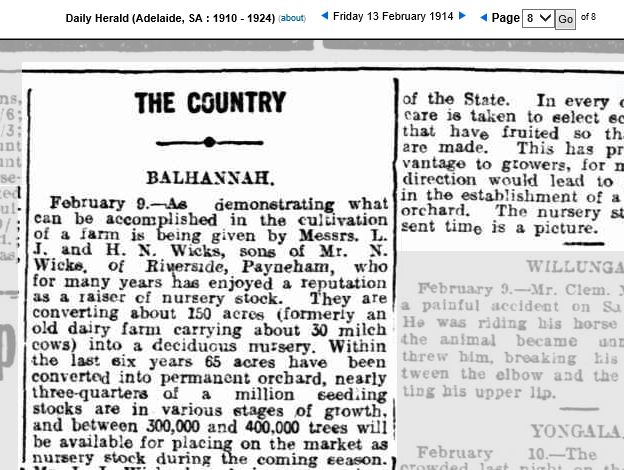
A search through TROVE located an article on page 8 of the "Daily Herald" [Adelaide, SA: 1910-1922] for Friday 13 February 1914, which places H N Wicks at Balhannah, helping establish an orchard and nursery.
H N Wicks appears in the book "Who's Who: South Australian Centenary, 1936." He is also mentioned in the 21 March 1934 ( page 13) edition of the "The Advertiser" Adelaide, as at the Balhannah flower show, see the image below.

It is therefore, a reasonable assumption that H N Wicks may have been present on 23 March 1920 in Adelaide, at Balhannah, as he states in his 1947 letter to the editor.
3. The weather
H N Wicks' 1947 letter to the editor, described the day of his observation, as "cloudless." Can we confirm this?
I checked the weather section of the 23 March 1920 "The Advertiser," Adelaide for the state forecast. This read "Lower South Australia Fine with warmer temperatures and light, variable winds, chiefly south-east to north-east." There is no mention about the state of cloudiness. Fine, merely means, no rain.
 |
| Advertiser, Adelaide 23 March 1920. |
4. Discussion
What might the two objects have been?
a. My first thoughts were that, could Wicks have possibly confused the aircraft he thought was Butler's, with Ross Smith's? If this were so, perhaps the two black objects were in fact Butler's and Moore's aircraft? However, Butler's aircraft was a monoplane, and Smith's was a much larger biplane. In addition, Smith's plane would not have been performing acrobatics and stunting, whereas Butler's smaller, monoplane was capable of acrobatics and stunting; in fact, Butler was renown for his acrobatic performances. It would seem, from the available facts, that H N Wicks was indeed watching Butler's aircraft when the black objects went by.
b. Could the two black objects have been birds? High speed black objects in the sky could indeed have been birds. However, if we accept that three independent witnesses all saw large objects at around the same time, from distances up to a mile apart, this suggestion would seem unlikely.
c. I note that there is no mention of the two black objects leaving a condensation trail. There is also no associated noise reported from the objects.
5. In summary
What might the two objects have been?
a. My first thoughts were that, could Wicks have possibly confused the aircraft he thought was Butler's, with Ross Smith's? If this were so, perhaps the two black objects were in fact Butler's and Moore's aircraft? However, Butler's aircraft was a monoplane, and Smith's was a much larger biplane. In addition, Smith's plane would not have been performing acrobatics and stunting, whereas Butler's smaller, monoplane was capable of acrobatics and stunting; in fact, Butler was renown for his acrobatic performances. It would seem, from the available facts, that H N Wicks was indeed watching Butler's aircraft when the black objects went by.
b. Could the two black objects have been birds? High speed black objects in the sky could indeed have been birds. However, if we accept that three independent witnesses all saw large objects at around the same time, from distances up to a mile apart, this suggestion would seem unlikely.
c. I note that there is no mention of the two black objects leaving a condensation trail. There is also no associated noise reported from the objects.
5. In summary
We have confirmed that H N Wicks was a real, historical figure, almost certainly living in Balhannah on 23 March 1920, the date he reports his observation occurred. The other details of the day, e.g.. the arrival of Sir Ross Smith, are historically correct.
Here then we have an observation, dated 23 March 1920, of "...two large black objects travelling at terrific speed in a parallel course, passed very high above him, travelling from north to south. These were quite large and were very high but nevertheless their speed was such as to make Harry Butler's machine appear as if it were stationary." These were reportedly observed by three people who were a considerable distance apart, albeit belatedly reported in February 1947. There, however, appears to be a valid reason why H N Wicks only reported it to the newspaper, in February 1947. The observation predates Kenneth Arnold's sighting, by several months.
On the reported facts, I have no suggestions as to a mundane stimulus for this observation.
Have any readers, ideas?
Update 29 Dec 2015
Sydney based researcher Bill Chalker forwarded me his thoughts:
http://australianhistoricaluforeports.blogspot.com.au/2015/12/a-probable-explanation-for-recollection.html
Update 29 Dec 2015
Sydney based researcher Bill Chalker forwarded me his thoughts:
http://australianhistoricaluforeports.blogspot.com.au/2015/12/a-probable-explanation-for-recollection.html
Sunday, December 27, 2015
"A strange light" - Rockhampton, Queensland - 17 October 1931
Hi readers,
When searching the National Library of Australia's TROVE digitised newspaper collection using the keywords "strange light" I came across the following article.
"A strange light
Seen in the west
Independent observers.
Hlamy writes: Please allow me a small space in your valuable paper to write of a strange trail of light seen in the western sky between 6.30 and 7pm Saturday evening October 17th. When first seen, this trail of light was shaped like a capital "I" or figure "7", then it changed into a long wavy line like a great serpent. Much brighter and bigger at the lower end. It stayed in the sky about twenty minutes and then suddenly disappeared. The two snapshots enclosed are time exposures of one minute, taken at fifteen minutes to 7 o'clock. Note the small star at the lower end of the trail.
Stockman: Who else besides myself saw the wonderful sight in the western sky on Saturday evening 17th saw this dazzling affair. The sun was down a good time and the moon's light not very bright. The time must have been a little past 7 o'clock. The affair resembled a thick snake, head downwards, all brilliant white, while several clouds nearby were quite black. In fact there was not another white cloud in the sky. It held its shape for a while. Then the tail changed and it started to pale, turning pink as it did so. The head stayed strong and pink to the last, I had no watch but before it paled I had ridden a mile watching it all the time. I had an idea it came on suddenly, as I shut a gate several minutes before and saw nothing.
Superstitious people will be wondering what it fortells. I'm trying to believe our long delayed rain is close at hand.

A mysterious phenomenon was witnesses by many residents as dusk was approaching on Saturday evening last, says our Winton correspondent. It took the form, when first observed of, a pencil of white steam-like substance.
It was located in the sky, south of Winton, at an altitude of about half way between the horizon and the zenith close to the two pointers of the southern cross. The mysterious white streak stood almost vertical and unravelled slowly downwards at the same time growing thicker, until it was about the length (to the eye) of the distance between the southern cross pointers.

After about ten minutes it began to bend as if blown by an air current, and assumed the shape of a reverse mark of interrogation. The lower end was now in the shape of an arrow head and drifted lower and in a westerly direction, until a s darkness came on, it faded from view.
An enormous meteor or falling star, which fell in a north-westerly direction was observed in the Winton district. It reached the dimensions of a huge electric light and had a brilliant red sword-like tail. Meteors have been seen in the Alpha district recently."
Source: "Morning Bulletin" [Rockhampton, Qld: 1878=1954] Wednesday 21 October 1931 p6.
1. Rockhampton, Queensland is at latitude 27 deg 24 mins south; longitude 150 deg 30 mins east.
2. The sun set that night at 6.03pm [UTC plus 10 hours.]
3. At 6.45 pm the sun was 9 degrees below the horizon at azimuth 15 deg south of west.
4. The moon was at 69 degrees elevation; azimuth 29 deg south of west.
5. From Rockhampton it was seen to the west, and from Winton it was seen to the south. Looking at a map this seems to indicate it was the one object seen from these localities.
6. All the details suggest that the observers were watching the trail of a bright meteor, distorted by high altitude winds.
When searching the National Library of Australia's TROVE digitised newspaper collection using the keywords "strange light" I came across the following article.
"A strange light
Seen in the west
Independent observers.
Hlamy writes: Please allow me a small space in your valuable paper to write of a strange trail of light seen in the western sky between 6.30 and 7pm Saturday evening October 17th. When first seen, this trail of light was shaped like a capital "I" or figure "7", then it changed into a long wavy line like a great serpent. Much brighter and bigger at the lower end. It stayed in the sky about twenty minutes and then suddenly disappeared. The two snapshots enclosed are time exposures of one minute, taken at fifteen minutes to 7 o'clock. Note the small star at the lower end of the trail.
Another observer
Stockman: Who else besides myself saw the wonderful sight in the western sky on Saturday evening 17th saw this dazzling affair. The sun was down a good time and the moon's light not very bright. The time must have been a little past 7 o'clock. The affair resembled a thick snake, head downwards, all brilliant white, while several clouds nearby were quite black. In fact there was not another white cloud in the sky. It held its shape for a while. Then the tail changed and it started to pale, turning pink as it did so. The head stayed strong and pink to the last, I had no watch but before it paled I had ridden a mile watching it all the time. I had an idea it came on suddenly, as I shut a gate several minutes before and saw nothing.
Superstitious people will be wondering what it fortells. I'm trying to believe our long delayed rain is close at hand.

Almost vertical
A mysterious phenomenon was witnesses by many residents as dusk was approaching on Saturday evening last, says our Winton correspondent. It took the form, when first observed of, a pencil of white steam-like substance.
Photo
It was located in the sky, south of Winton, at an altitude of about half way between the horizon and the zenith close to the two pointers of the southern cross. The mysterious white streak stood almost vertical and unravelled slowly downwards at the same time growing thicker, until it was about the length (to the eye) of the distance between the southern cross pointers.
After about ten minutes it began to bend as if blown by an air current, and assumed the shape of a reverse mark of interrogation. The lower end was now in the shape of an arrow head and drifted lower and in a westerly direction, until a s darkness came on, it faded from view.
Enormous meteor
An enormous meteor or falling star, which fell in a north-westerly direction was observed in the Winton district. It reached the dimensions of a huge electric light and had a brilliant red sword-like tail. Meteors have been seen in the Alpha district recently."
Source: "Morning Bulletin" [Rockhampton, Qld: 1878=1954] Wednesday 21 October 1931 p6.
Notes
1. Rockhampton, Queensland is at latitude 27 deg 24 mins south; longitude 150 deg 30 mins east.
2. The sun set that night at 6.03pm [UTC plus 10 hours.]
3. At 6.45 pm the sun was 9 degrees below the horizon at azimuth 15 deg south of west.
4. The moon was at 69 degrees elevation; azimuth 29 deg south of west.
5. From Rockhampton it was seen to the west, and from Winton it was seen to the south. Looking at a map this seems to indicate it was the one object seen from these localities.
6. All the details suggest that the observers were watching the trail of a bright meteor, distorted by high altitude winds.
The first published Australian report of a UFO sighting?
Hi readers,
"From their own research, Australian ufologists believe that the first published report of the sighting of an unidentified flying object in this country occurred as far back as October 1874, at Beechworth in Victoria."
So wrote author Stephen Holledge, on page two of his 1965 Australian book titled "Flying Saucers Over Australia" (published by Horwitz. Sydney.) However, no one to my knowledge has ever been able to precisely pin down what was seen, and when in October 1874, this happened. In version three of my catalogue of Australian pre 24 June 1947 sightings, I mentioned that I had been unable to ascertain further details.
I therefore recently conducted a search of TROVE newspapers for the Beechworth area of Victoria, for October 1874, and located one article which may have been the source of the observation referred to by Holledge.
The "Avoca Mail" dated Thursday 13 October 1874 on page 2, reported that at 6.15pm on Sunday 4 October 1874, inhabitants of Beechworth reported an unusual sight in the sky. The sun had already set when at 60 degrees elevation in the north-north-west appeared what seemed a flash of lightning. A "...brilliant and beautiful meteor" appeared, with its head said to have been larger than Venus. It left behind a silver tail which stretched from 60 degrees elevation to the horizon. At one point this trail looked like the "shape of a gigantic snake." This took some 15 minutes to disappear. The sky was clear at the time. The article mentions that the same thing was seen from the localities of Chilton and Wagga Wagga.

Similar accounts are to be found in the Melbourne "Argus" dated Monday 12 October 1874 page 6; and the "Sydney Morning Herald" dated Friday 9 October 1874 page 2.
The wide geographic distribution of sightings indicates that the object was most probably a meteor leaving a vivid trail in the sky, blown about by high altitude atmospheric winds.
"From their own research, Australian ufologists believe that the first published report of the sighting of an unidentified flying object in this country occurred as far back as October 1874, at Beechworth in Victoria."
So wrote author Stephen Holledge, on page two of his 1965 Australian book titled "Flying Saucers Over Australia" (published by Horwitz. Sydney.) However, no one to my knowledge has ever been able to precisely pin down what was seen, and when in October 1874, this happened. In version three of my catalogue of Australian pre 24 June 1947 sightings, I mentioned that I had been unable to ascertain further details.
I therefore recently conducted a search of TROVE newspapers for the Beechworth area of Victoria, for October 1874, and located one article which may have been the source of the observation referred to by Holledge.
The "Avoca Mail" dated Thursday 13 October 1874 on page 2, reported that at 6.15pm on Sunday 4 October 1874, inhabitants of Beechworth reported an unusual sight in the sky. The sun had already set when at 60 degrees elevation in the north-north-west appeared what seemed a flash of lightning. A "...brilliant and beautiful meteor" appeared, with its head said to have been larger than Venus. It left behind a silver tail which stretched from 60 degrees elevation to the horizon. At one point this trail looked like the "shape of a gigantic snake." This took some 15 minutes to disappear. The sky was clear at the time. The article mentions that the same thing was seen from the localities of Chilton and Wagga Wagga.

Similar accounts are to be found in the Melbourne "Argus" dated Monday 12 October 1874 page 6; and the "Sydney Morning Herald" dated Friday 9 October 1874 page 2.
The wide geographic distribution of sightings indicates that the object was most probably a meteor leaving a vivid trail in the sky, blown about by high altitude atmospheric winds.
Tuesday, December 22, 2015
The "inhabited sky" conference
Hi readers,
The "El Cielo habitado" conference, was held in Madrid, Spain over two days, 27-28 May 2015, and was organised by Chris Aubeck. Included in the event were presentations by Jacques Vallee; Chris Aubeck; Nigel Watson; Theo Paijmans; Jesus Callejo; and Juan Jose Sanchez-Oro.
Nigel Watson reviewed the media reporting of advances in aviation and space travel and its shaping of cultural responses.
Theo Paijmans examined the early twentieth century cultural impact of comics and other forms of literature, in relation to the phenomena.
There was then a question and answer time with Jacques Vallee and Chris Aubeck.
The "El Cielo habitado" conference, was held in Madrid, Spain over two days, 27-28 May 2015, and was organised by Chris Aubeck. Included in the event were presentations by Jacques Vallee; Chris Aubeck; Nigel Watson; Theo Paijmans; Jesus Callejo; and Juan Jose Sanchez-Oro.
On the 27th
Jacques Vallee spoke on the social impact of reports of anomalous phenomena through the ages.
Nigel Watson reviewed the media reporting of advances in aviation and space travel and its shaping of cultural responses.
Theo Paijmans examined the early twentieth century cultural impact of comics and other forms of literature, in relation to the phenomena.
There was then a question and answer time with Jacques Vallee and Chris Aubeck.
On the 28th
Juan Jose Sanchez-Oro, examined medieval art in search of clues to reports of that era.
Chris Aubeck covered the idea of a populated universe from Ancient Greece to the beginning of the modern era of "flying saucers."
Jesus Callejo, a journalist and author of over twenty books on history and folklore, spoke about the idea of flying machines before these were known in orthodox history.
Books
 |
| Image courtesy of Amazon Books. |
For those blog readers interested in reading more on these topics, you might like to take a look at "Wonders in the Skies" by Jacques Vallee and Chris Aubeck.
For any blog readers who can read Spanish, take a look at "Ooparts: Objetos fuera de su tiempo" (Objects out of time) by Juan Jose Sanchez-Oro and Chris Aubeck.
 |
| Image courtesy of Amazon Books. |
Videos
A number of conference presentations are available on Youtube, including the following:
Jacques Vallee.
Chris Aubeck.
Nigel Watson.
Jacques Vallee.
Chris Aubeck.
Nigel Watson.
Alternative view
Jason Colavito, is a US author, editor, and blogger, who refers to himself as a "sceptical xenoarchaeologist." After the conference, Colavito posted a review of some of Jacques Vallee's presentation. Colavito has previously published pieces, critical of Vallee's work in this area, which may be read here and here. Other pieces about Vallee's work, by Colavito appear here , here , and here.
Subscribe to:
Posts (Atom)